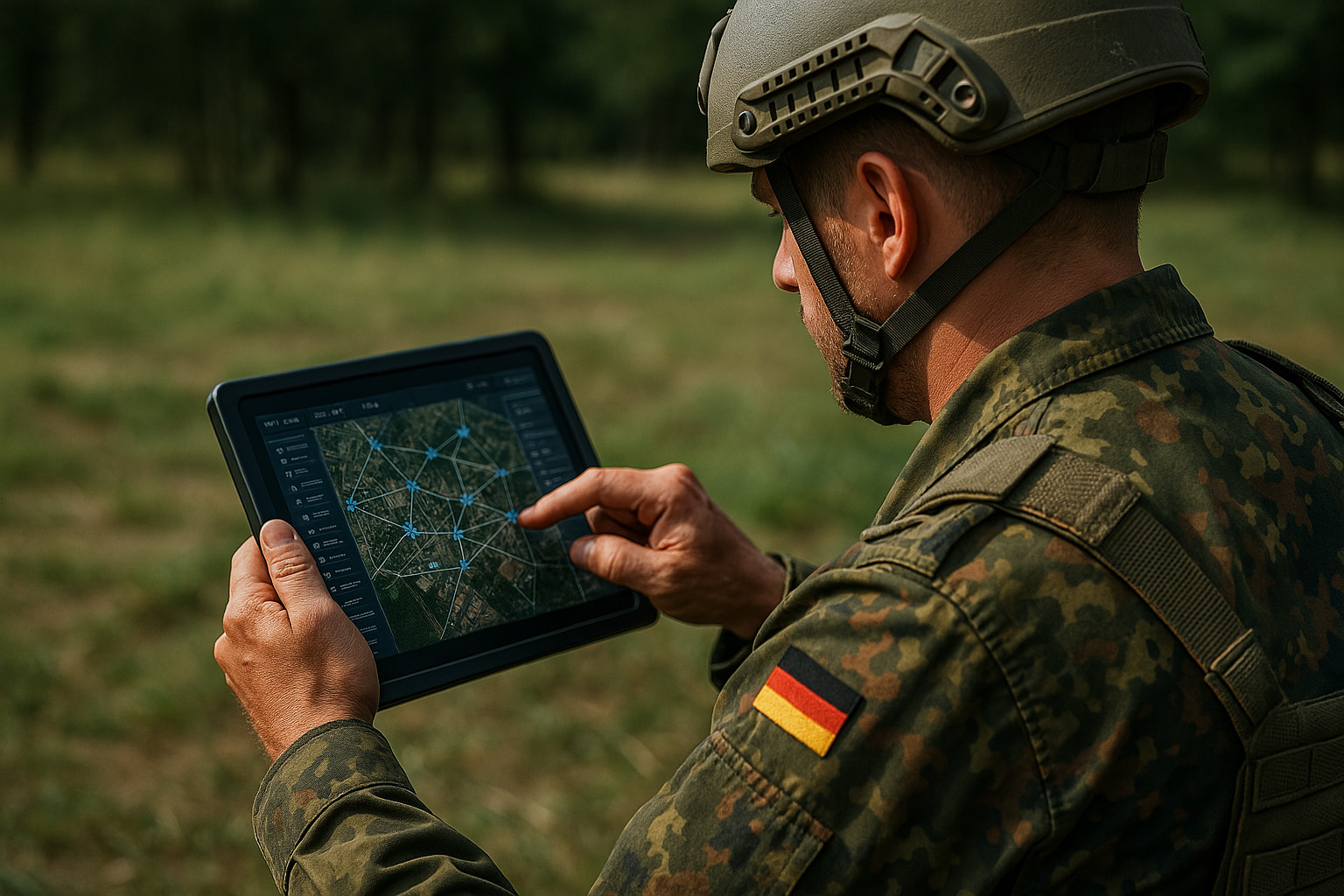
With this project, the German Armed Forces are pursuing Digitalization of land-based operations (D-LBO) A central goal: to digitally connect tactical levels — from mobile devices to command posts. Robust, dynamic networks should ensure seamless, secure communication even under rapidly changing conditions and enable the exchange of information in real time.
more than hardware: why leadership starts with software
In numerous application scenarios, the quality of the available information determines response speed and effectiveness. A future-oriented software architecture must therefore:
- provide real-time capability
- enable role-based and context-based access
- work interoperably with different (legacy) systems,
- and meet security requirements up to “NATO Restricted.”
This turns pure infrastructure into an adaptive ecosystem that adapts to changes in the situation and supports data-based decisions.
three technical priorities for D-LBO
A central aspect of modern software solutions in the D-LBO context is modular development: Adaptable components can be specifically integrated into tactical networks. At the same time, the use of agile methods and automated processes (DevOps) increases the speed of development and deployment. Quality assurance is continuous and practical — for example through simulated test environments and defined quality criteria.
This approach ensures that new features are not only deployed quickly but also reliably.
comparing modern communication solutions
In contrast to traditional systems, modern communication solutions offer a variety of technical advantages. Open standards and API-based interfaces enable a high level of interoperability. Dynamic network topologies and cloud edge combinations provide scalability and flexibility. At the same time, the security architectures are designed to meet even the highest requirements — for example through zero-trust concepts and certifications up to the “NATO Restricted” level.
Continuous practical testing is particularly crucial: Functions are iteratively reviewed and developed together with users.
technical requirements in the D-LBO context
D-LBO requires software solutions that enable reliable network communication even under demanding operating conditions. Decision-making processes and data analysis should be increasingly supported by AI. Modularity and expandability play just as important a role as robust testing and validation mechanisms. In addition, relevant KPIs must be continuously recorded and presented transparently in order to be able to effectively manage development and operation.
findings from practice
Experience from real projects shows that early automation of tests significantly reduces sources of error in later development phases. High test coverage and realistic test environments increase the reliability of complex systems. KPIs such as test coverage, deployment frequency, or response times to errors (mean time to recovery) provide valuable information about the maturity of a product.
These findings are continuously incorporated into the further development of development and QA processes — with the aim of providing robust and resilient software solutions.
outlook
The digitization of land-based operations is a long-term transformation project. Open, scalable software architectures make it possible to integrate sensors, effectors and control systems in a flexible network network. This requires seamless interaction between development, quality assurance and operation — this is the only way D-LBO can develop its full potential for the armed forces.